
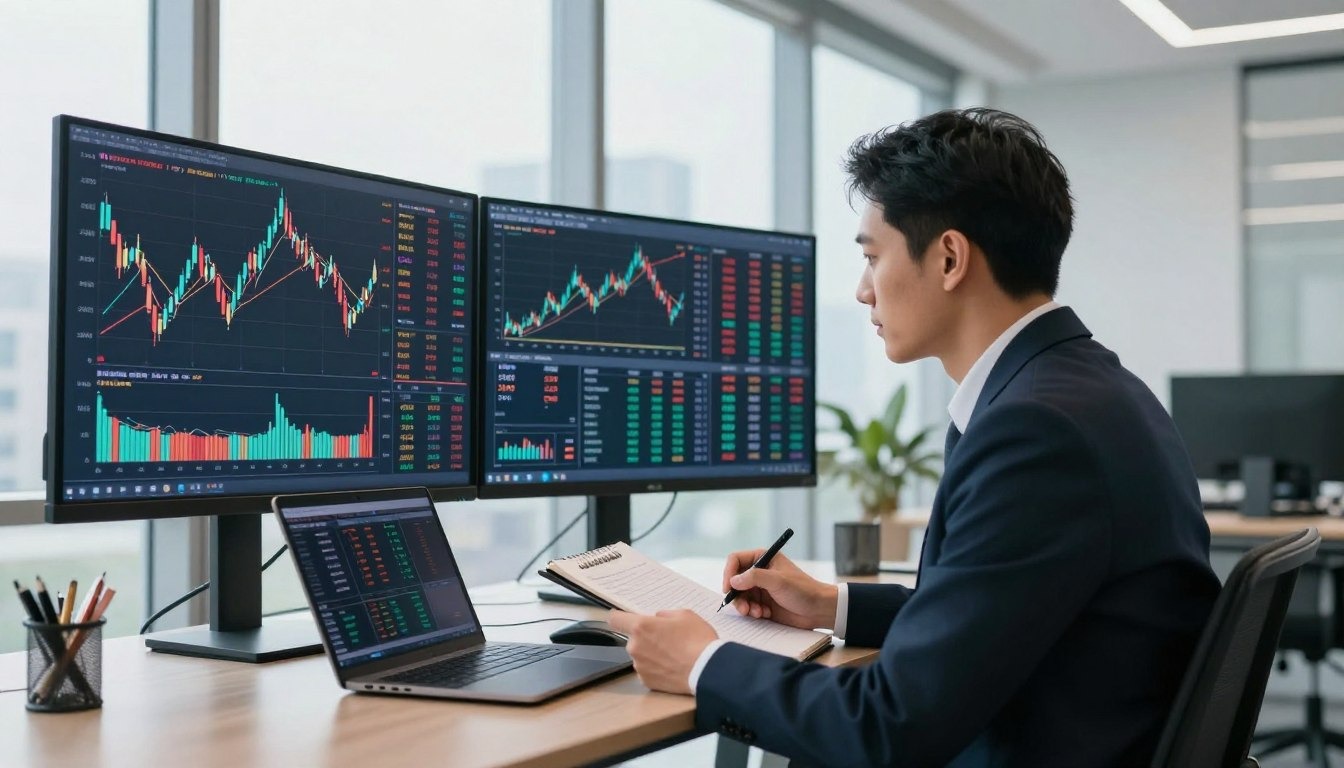
Getting into the digital asset world is not just about luck. Investors often find it hard to make sense of the ups and downs in prices and all the social chatter. Learning how to analyze cryptocurrency market trends like a professional trader helps you make informed choices.
To succeed in this fast world, you need to know technical and fundamental indicators well. Looking at trading volume, chart patterns, and big economic changes can keep you ahead. This guide will show you strategies used by experts in the blockchain world.
How to Analyze Cryptocurrency Market Trends Like a Professional Trader
Being disciplined is key to managing risks and finding good opportunities. Developing a sharp eye for detail keeps your portfolio strong, no matter the mood. Let’s look at the important tools for mastering market analysis.
Key Takeaways
- Identify cycles using historical price data.
- Monitor trading volume to confirm price movements.
- Use fundamental analysis for long-term project viability.
- Implement risk management strategies for capital protection.
- Stay updated on global regulatory changes.
- Leverage sentiment indicators for emotional balance.
Understanding the Fundamentals of Cryptocurrency Market Analysis
Professional traders in the cryptocurrency market rely on a solid grasp of market basics. This knowledge gap between pros and amateur investors is huge. Closing it is key to success in the unpredictable cryptocurrency market.
What Separates Professional Traders from Amateur Investors
Professional traders stand out by their disciplined approach to analysis, risk management, and decision-making. They mix technical and fundamental analysis to forecast market trends.
Key characteristics of professional traders include:
- A deep understanding of market dynamics
- The ability to analyze complex data sets
- A disciplined risk management strategy
The Core Principles of Market Trend Analysis
Market trend analysis focuses on the forces behind market shifts. It involves studying past data, spotting patterns, and understanding external influences.
The core principles include:
| Principle | Description |
| Trend Identification | Recognizing the direction and strength of market trends |
| Pattern Recognition | Identifying historical patterns that may predict future market movements |
| External Factors Analysis | Assessing the impact of external events on market trends |
Essential Market Dynamics in Cryptocurrency Trading
Cryptocurrency trading is shaped by unique market dynamics. These include supply and demand, market sentiment, and regulatory changes.
Understanding these dynamics is crucial for:
- Predicting market volatility
- Identifying trading opportunities
- Managing risk effectively
Mastering Technical Analysis Indicators for Crypto Markets
Technical analysis indicators are key for traders in crypto markets. They offer insights into market trends. This helps traders make better decisions.
Moving Averages and Their Application in Crypto Trading
Moving averages are a top choice for crypto traders. They smooth out price data, making trends easier to spot.
Simple Moving Averages (SMA) for Trend Identification
Simple Moving Averages (SMA) average out a crypto’s price over time. They show the trend and support or resistance levels. For example, a 50-day SMA shows short-term trends, while a 200-day SMA shows long-term trends.
Exponential Moving Averages (EMA) for Faster Signals
Exponential Moving Averages (EMA) focus more on recent prices. This makes them quick to react to price changes. They’re great for fast-moving crypto markets.
Relative Strength Index (RSI) for Momentum Analysis
The Relative Strength Index (RSI) checks recent price changes. It shows if prices are too high or too low. Values over 70 mean prices are high, and values under 30 mean they’re low. This helps spot when prices might change direction.
MACD: Identifying Trend Changes and Momentum Shifts
The Moving Average Convergence Divergence (MACD) tracks two moving averages. It shows when trends might change. When the MACD line goes up, it’s a sign of a possible uptrend.
Bollinger Bands for Volatility Assessment
Bollinger Bands use a moving average and two standard deviations. They adjust to how volatile the market is. Traders use them to see market volatility and find good times to buy or sell.
Reading Price Action and Chart Patterns
Understanding price action and chart patterns is key for successful traders. It helps them make smart trading choices in the crypto market.
Candlestick Patterns Every Professional Trader Recognizes
Candlestick patterns give insights into market mood and future price moves. They are vital for grasping market psychology.
Bullish Reversal Patterns
Bullish patterns show a shift from down to up trends. The Hammer and Inverted Hammer patterns signal buying pressure and trend reversals.
Bearish Reversal Patterns
Bearish patterns hint at a shift from up to down trends. The Shooting Star and Hanging Man patterns indicate selling pressure.
Continuation Patterns
Continuation patterns suggest the trend will keep going. The Ascending Triangle and Descending Triangle patterns are important for trend continuation.
| Pattern Type | Pattern Name | Description |
| Bullish Reversal | Hammer | Indicates a potential uptrend reversal with a small body and long lower wick. |
| Bearish Reversal | Shooting Star | Suggests a potential downtrend reversal with a small body and long upper wick. |
| Continuation | Ascending Triangle | Indicates a likely continuation of an uptrend with converging trend lines. |
Support and Resistance Levels in Crypto Markets
Knowing support and resistance levels is crucial. Support levels stop price falls, while resistance levels stop price rises.
Trend Lines and Channel Trading
Trend lines show trend direction and strength. Channel trading uses parallel lines to forecast price movements, helping find entry and exit points.
Mastering these price action and chart pattern skills boosts trader strategies and expert analysis.
Volume Analysis: The Hidden Key to Market Validation
In the world of cryptocurrency trading, volume analysis is key. It shows the strength of market movements. It gives cryptocurrency market insights that traders find very useful.
Volume analysis uses many techniques and indicators. These help traders understand market sentiment and future movements. By looking at volume profiles, traders can see trading activity and its impact on trends.
Understanding Volume Profiles and Trading Activity
Volume profiles show trading activity at different prices over time. This info is key for finding high liquidity areas and seeing how traders are positioned.
High volume nodes in a profile show big trading activity at certain prices. These are often strong support or resistance areas. Low volume nodes mean traders don’t have much interest at those prices.
Volume-Price Trend Analysis
Looking at volume and price trends is vital. A price rise with rising volume is a strong trend sign. But, a price rise with falling volume might mean the trend is weakening.
This analysis helps traders know real trend movements from potential reversals or consolidations. By looking at volume and price together, traders can make better decisions.
On-Balance Volume (OBV) Indicator
The On-Balance Volume (OBV) indicator shows volume and price change. It says volume comes before price, giving early signs of trend changes.
- A rising OBV means buying pressure, likely leading to higher prices.
- A falling OBV shows selling pressure, possibly leading to lower prices.
Interpreting Volume Spikes and Divergences
Volume spikes and divergences are important in volume analysis. A volume spike means a big reaction to news or events.
Divergences between volume and price action offer insights. For example, a price peak with a volume divergence might signal a reversal.
By using volume analysis in their strategies, cryptocurrency traders can get better cryptocurrency market insights. This can lead to more informed decisions and better trading results.
How to Analyze Cryptocurrency Market Trends Like a Professional Trader Using Fundamental Analysis
Professional traders use fundamental analysis to understand the cryptocurrency market better. This helps them make smarter trading choices. They look at many factors like blockchain metrics, tokenomics, news, and regulations.
Evaluating Blockchain Metrics and On-Chain Data
Blockchain metrics and on-chain data offer insights into a cryptocurrency’s health and future. Traders use these to see how active and interesting a cryptocurrency is.
Transaction Volume and Network Activity
Transaction volume shows how active a network is. More transactions mean a busier and stronger network. Watching transaction volume helps traders see how much a cryptocurrency is used.
Active Addresses and User Growth
The number of active addresses shows how many users are using a cryptocurrency. Growth in active addresses means more people are using it, which could lead to higher prices.
Hash Rate and Network Security
The hash rate measures a blockchain’s security. A higher hash rate means a safer network. Changes in hash rate can show if miners are changing their behavior, affecting the network’s security.
Analyzing Tokenomics and Supply Dynamics
Tokenomics studies a cryptocurrency’s token design and economics. Knowing about token supply is key to guessing its future value.
- Total supply and circulating supply
- Token distribution and concentration
- Token burn mechanisms and inflation rate
News Events and Market Impact Assessment
News can greatly affect cryptocurrency markets. Traders need to keep up with news and think about its market impact.
- Partnership announcements and technological advancements
- Regulatory changes and government policies
- Market trends and sentiment shifts
Regulatory Developments and Their Influence
Regulatory changes can deeply affect cryptocurrency markets. Knowing the regulatory scene and expecting changes is crucial for smart trading.
By using fundamental analysis, professional traders get a better grasp of the cryptocurrency market. This helps them make more informed trading decisions.
Market Sentiment Analysis and Social Indicators
Market sentiment analysis lets traders see the cryptocurrency market in a new way. It helps them understand the feelings and views of others. This can lead to better decisions and a chance to outperform in the market.
Understanding market sentiment is key in cryptocurrency analysis. It greatly affects market trend analysis. Positive sentiment can push the market up, while negative can pull it down.
Gauging Market Psychology and Trader Sentiment
To grasp market psychology, we look at the feelings of traders and investors. We use surveys, sentiment tools, and social media to do this.
A well-known cryptocurrency analyst says, “Knowing market sentiment is more than just knowing if it’s up or down. It’s about understanding the reasons behind it.”
“The market is a voting machine in the short run but a weighing machine in the long run.”
Benjamin Graham
Social Media Metrics and Community Engagement
Social media metrics give us clues about community feelings and activity. By looking at social media, we can see how interested people are in certain cryptocurrencies. This helps spot trends.
| Social Media Metric | Description | Importance |
| Engagement Rate | Measures the level of interaction with content | High engagement shows strong support |
| Sentiment Analysis | Analyzes the tone of social media posts | Helps understand overall market mood |
| Follower Growth Rate | Tracks changes in followers | Shows if interest is growing or falling |
Fear and Greed Index for Crypto Markets
The Fear and Greed Index measures market sentiment. It looks at volatility, momentum, and social media feelings.
Whale Wallet Tracking and Large Holder Behavior
Tracking whale wallets means watching the big players in the crypto world. Their moves can hint at future market directions.
As the crypto market grows, knowing about market sentiment and social signs is vital. It helps traders stay ahead.
Professional Trading Strategies for Trend Identification
Professional traders use many strategies to spot and use cryptocurrency market trends. These methods help them navigate the unpredictable crypto world and increase their investment returns.
Trend Following Strategies for Long-Term Positions
Trend following is a favorite strategy among pros. It means finding established trends and sticking with them for the best profit. This method needs patience and a good grasp of market movements.
Key elements of trend following include:
- Identifying the primary trend direction
- Using technical indicators to confirm the trend
- Setting appropriate stop-loss levels
Swing Trading Techniques for Crypto Volatility
Swing trading is great for the fast-changing crypto markets. It aims to make gains in a short time, usually a few days or weeks.
Successful swing trading requires:
- Accurate market timing
- Understanding of market sentiment
- Ability to react quickly to market changes
Breakout Trading and Entry Point Optimization
Breakout trading finds key support or resistance levels and enters trades when they’re broken. Finding the best entry points is key to making more money.
Effective breakout trading strategies include:
- Monitoring volume to confirm breakouts
- Using technical indicators to predict potential breakouts
- Setting stop-loss orders to limit potential losses
Multi-Timeframe Analysis for Comprehensive Market Views
Multi-timeframe analysis is a strong tool. It looks at the same asset in different time frames to understand market trends fully.
Daily Charts for Primary Trend Direction
Daily charts give a wide view of the market. They help traders see the main trend direction.
Four-Hour Charts for Entry Timing
Four-hour charts give more detailed insights. They help traders find the best time to enter trades.
By mixing these strategies, professional traders can better spot and use cryptocurrency market trends.
Risk Management Techniques Used by Professional Traders
Traders in the crypto market face many risks. They use strong risk management strategies to deal with these risks. It’s not just about avoiding losses; it’s also about making the most of gains.
“Risk management is the most important thing you need to learn to be a successful trader,” says Alexander Elder, a well-known trader and author. This shows how vital risk management is in trading.
Position Sizing and Capital Allocation
Position sizing is key in managing risk. It’s about figuring out how much capital to use for each trade. Many traders risk a set percentage of their total capital on each trade.
For example, risking 2% of their capital, a trader adjusts the trade size based on the stop-loss and asset volatility. This method helps control risk and prevent big losses.
Stop-Loss Placement Strategies
Stop-loss orders are essential for limiting losses. There are various ways to place these orders, including:
Fixed Percentage Stop-Loss
A fixed percentage stop-loss sets a stop-loss order at a certain percentage below the entry price. For instance, a 5% stop-loss on a long position. This method is simple but might not consider the asset’s volatility.
Technical Level Stop-Loss
Placing stop-loss orders at technical levels like support or resistance is more advanced. It considers the asset’s price action and volatility, offering a more detailed risk management strategy.
Risk-Reward Ratio Calculation
The risk-reward ratio is crucial for traders to assess trade potential. It’s the potential profit divided by the potential loss. A common goal is a 1:2 ratio, where profit is twice the loss.
For example, a 5% stop-loss and a 10% take-profit give a 1:2 ratio. This ratio helps identify trades likely to be profitable.
Portfolio Diversification in Cryptocurrency Markets
Diversification is key in managing risk. Spreading investments across different assets reduces exposure to any one asset’s volatility. In crypto, diversification might include large-cap coins, mid-cap coins, and DeFi tokens or NFTs.
As Nassim Nicholas Taleb said, “Diversification is the only free lunch in finance.” This emphasizes the need to spread risk across various investments for stable returns.
Essential Tools and Platforms for Professional Crypto Analysis
Cryptocurrency market insights are greatly improved by using advanced tools and platforms. Professional traders and analysts use many resources to keep up with trends and make smart choices.
Advanced Charting Platforms
Advanced charting platforms are key for technical analysis in crypto trading. They offer detailed charts and indicators to spot patterns and trends.
TradingView for Technical Analysis
TradingView is a top pick for traders because of its detailed charts and community features. It has many technical indicators and lets users share and talk about their analyses.
Key Features of TradingView:
- Extensive library of technical indicators
- Customizable charts and layouts
- Community sharing and discussion tools
Coinigy for Multi-Exchange Analysis
Coinigy is a powerful tool for analyzing multiple exchanges from one place. It offers real-time data and advanced charting features.
Benefits of Using Coinigy:
- Unified view of multiple exchanges
- Real-time market data
- Advanced trading capabilities
On-Chain Analysis Tools
On-chain analysis tools give valuable insights into blockchain data. They help traders understand market dynamics and make better decisions.
Glassnode for Blockchain Metrics
Glassnode offers a wide range of blockchain metrics for analyzing market trends and sentiment. It includes data on transaction volumes, wallet activity, and more.
CryptoQuant for Exchange Flow Data
CryptoQuant provides detailed data on exchange flows. It helps traders understand the movement of cryptocurrencies into and out of exchanges.
Key Insights from CryptoQuant:
- Exchange inflow and outflow data
- Wallet and transaction analysis
- Market sentiment indicators
Nansen for Smart Money Tracking
Nansen is a powerful tool for tracking smart money movements in the crypto market. It offers insights into the activities of large investors and whales.
News Aggregators and Alert Systems
Staying informed about market news and events is crucial for professional traders. News aggregators and alert systems help traders stay updated with the latest news.
These tools gather news from various sources and provide customizable alerts. This helps traders react quickly to market-moving events.
Conclusion
Mastering advanced trading methods is key to success in the cryptocurrency market. By using technical analysis, fundamental analysis, and market sentiment, traders can understand market trends well. This helps them make better decisions.
Learning and adapting are vital in the fast-changing crypto world. Keeping up with new market trends and improving trading strategies is crucial. It helps traders deal with the market’s complexities.
Using the insights and techniques shared, traders can make better choices and improve their results. The crypto market’s ups and downs offer both challenges and chances. Having advanced trading methods can greatly impact success.
FAQ
How can I begin to learn how to analyze cryptocurrency market trends like a professional trader?
To analyze markets like a pro, you need to switch from emotional trading to a data-driven approach. You must learn three key areas: technical analysis, fundamental analysis, and sentiment analysis. It’s also important to manage risks well and use platforms like TradingView for disciplined trading.
What are the most reliable indicators for cryptocurrency analysis?
Professional traders rely on lagging and leading indicators. They use Moving Averages for trend spotting, the Relative Strength Index for momentum, and Bollinger Bands for checking volatility. The MACD is also key for spotting trend reversals and shifts in assets like Bitcoin and Ethereum.
How does volume validation improve the accuracy of market trend analysis?
Volume is crucial for price movement. A price breakout with high volume shows strong interest and trend strength. But, a price rise with low volume might be a “fakeout.” Using On-Balance Volume and Volume Profiles helps confirm a move’s validity.
Which professional trading techniques are best for managing high crypto volatility?
To handle volatility, professionals use advanced methods like multi-timeframe analysis. They look at the Daily chart for the main trend and the Four-Hour or One-Hour charts for entry and exit points. They also use strict stop-loss and a good risk-reward ratio to protect capital.
Why is on-chain data essential for obtaining expert analysis of the crypto market?
On-chain data is key for crypto market insights. It includes metrics like Active Addresses, Exchange Inflow/Outflow, and Hash Rate. Tools like Glassnode and CryptoQuant help track “Smart Money” and whale behavior, offering insights not seen on standard charts.
What role does the Fear and Greed Index play in trader strategies?
The Fear and Greed Index is crucial for sentiment analysis. It acts as a contrarian indicator. Extreme fear can be a buying signal, while extreme greed signals a correction. Using sentiment metrics helps avoid FOMO traps.
Which platforms are recommended for executing advanced trading methods?
For advanced analysis, TradingView is the top choice for technical charting. Nansen is great for on-chain transparency, and Coinigy offers multi-exchange connectivity. These tools help execute complex strategies more precisely.
How do regulatory developments impact professional crypto market analysis?
Regulatory news can greatly affect the market. Professionals watch these changes closely as part of their analysis. Legal shifts can impact liquidity, adoption, and the long-term trend of digital assets.









Leave a Reply